Showing posts with label Geometry. Show all posts

Tuesday, August 5, 2014

Pythagorean Theorem: Practical use #1

Long ago in Ancient Greece, an influential philosopher and mathematician named Pythagoras made an important discovery that would affect our perception of the world.

This discovery, known as the Pythagorean Theorem states that: The sum of the squares of two of a right triangle is equal to the square of the hypotenuse of that same right triangle. Or in equation form:

a2 + b2 = c2
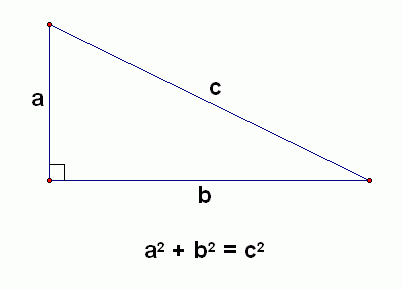

By using this equation we can find the length of any side of a right triangle provided we have the lengths of the other two sides. For example:


Likewise, this same theorem can be used to find unknown lengths of diagonals and sides in many polygons such as squares and rectangles. See the example below:


This is just one of many ways that the Pythagorean Theorem can be used. How might someone use this mathematical principle in the real world?


Surface Area of Solids

Trying to wrap a present? Using just the right amount of wrapping paper requires a knowledge of solids and surface area. You need to know the shape of box, container, etc. that you are wrapping and the correct surface area formula in order to determine how much paper you need to cover your gift.

 A solid is essentially comprised (made up of) several smaller 2D shapes. When we take the total surface area of a solid we are actually adding up the areas of all the 2D shapes.


The cube above is composed of 6 identical squares. The area of each square (on the right) is the same, so total surface area of the cube (on the left) is sum of the areas of all six squares. So if the sides of the square were 2cm, the area of one square is 2 x 2 = 4 sq. cm. The total surface area would then be 6(2 x 2) or 2x2 +2x2 +2x2 +2x2 +2x2 +2x2, which equals 24 sq. cm.

Below is a chart of sample solid shapes: